Entity Relations – Link entities intelligently
Define semantic relationships for better AI understanding
The Problem
AI search engines don't understand content through isolated keywords, but through entities (people, places, products, concepts) and their relationships to each other. When you mention "iPhone 15," AI should understand: manufactured by Apple, belongs to smartphone category, has relationship to iOS, competes with Samsung Galaxy.
Without explicit entity relations, AI models can only guess these connections, leading to inaccurate or missing citations. Your content is rated less authoritative than competitors with structured entity data.
Manual implementation of entity relations in Schema.org is extremely complex and requires deep semantic web knowledge that content teams don't have.
The Solution
Entity Relations allows you to visually define semantic relationships without Schema.org knowledge:
- Entity detection: AI scans your content and automatically identifies entities (people, places, products, organizations)
- Relationship builder: Visual interface for defining relationships (author, manufacturer, competitor, partOf, mentions, etc.)
- Pre-defined relations: Library with 100+ common relationship types according to Schema.org
- Auto-linking: Connection to Wikidata, Wikipedia, and DBpedia for external entity validation
- Schema generation: Automatic translation into correct JSON-LD schema markup
- Conflict detection: Warning for contradictory relations (e.g., "competitor" and "subsidiary" simultaneously)
The defined relations are output as extended Schema.org properties and are available for all AI crawlers.
See it in action
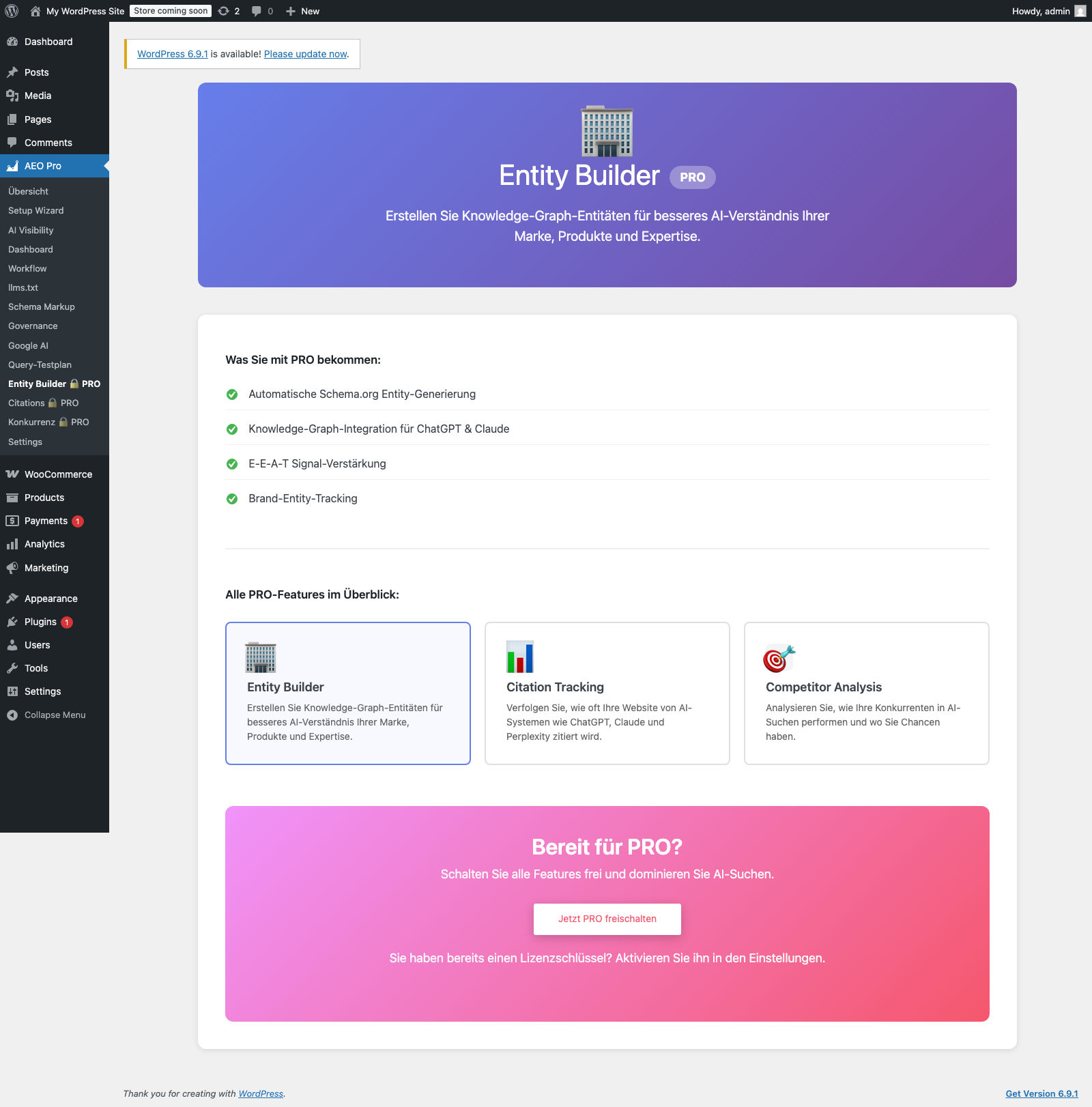
Source
Direct screenshot from the local WordPress test installation with AEO Pro active.
Context
Where only PRO lock states are currently visible, the module is presented as an existing expansion area rather than as a freely usable interface.
Benefits
Context becomes clearer
Explicit relations make it easier to understand how entities belong together instead of leaving that context implicit in the text.
Rich snippets & knowledge cards
Google uses entity relations for rich results. Sites with structured relations more often receive carousels, knowledge cards, and "People Also Search For" features.
Competitive differentiation
While 95% of sites only have basic entities, you stand out through detailed relations. AI models prefer sources with rich context.
No-code semantic web
Semantic web and Linked Data without RDF knowledge. Visual builder makes complex concepts accessible for content teams without technical background.
Wikidata authority
Linking with Wikidata lends your entities external authority. Google trusts Wikidata-linked relations more than isolated site data.
Automated maintenance
Entity detection runs continuously. When you mention new entities, the tool automatically suggests relations – no manual maintenance needed.
Use Cases
Tech blog: Product reviews with relations
A gadget blog links reviewed products with manufacturers, competitors, and predecessor/successor. ChatGPT can now answer questions like "What's the successor to iPhone 14?" and cites correctly. Traffic from AI comparison questions increases by 250%.
E-Commerce: Cross-selling through relations
A store defines "isAccessoryFor" relations between products. Google now shows "Goes with" suggestions in rich snippets. AI shopping assistants automatically recommend matching accessories. Average order value increases by 35%.
SaaS: Competitor comparisons
A CRM defines "competitor" relations to Salesforce, HubSpot, etc. For questions like "CRM alternative to Salesforce," the site now gets prominently cited. Traffic from comparison searches doubles.
Publisher: Authors & expert network
A magazine links authors with expertise areas (expert in "AI"), organizations (worksFor University), and co-authors. Google now shows author cards with credentials. Trust signals increase, rankings improve.