Multilingual – AEO for international websites
Handle multilingual content with clearer localized structure
The Problem
International websites with multiple languages have additional AEO challenges: each language version brings its own content, metadata, and structural questions.
Many SEO setups treat language versions too generically, even though editorial and market needs differ across locales.
Without a cleaner multilingual structure, maintenance quickly becomes inconsistent.
The Solution
The Multilingual feature is designed to make multilingual content handling more consistent instead of treating translated pages as an afterthought.
- Language-specific outputs: keep metadata and llms.txt handling clearer per language
- Localized structure: separate language variants more cleanly in the editorial workflow
- Score visibility: compare structural differences between language versions
- Plugin integration: connect to multilingual WordPress setups more cleanly
The focus is on cleaner multilingual structure, not on claiming frictionless support for every locale and plugin combination.
See it in action
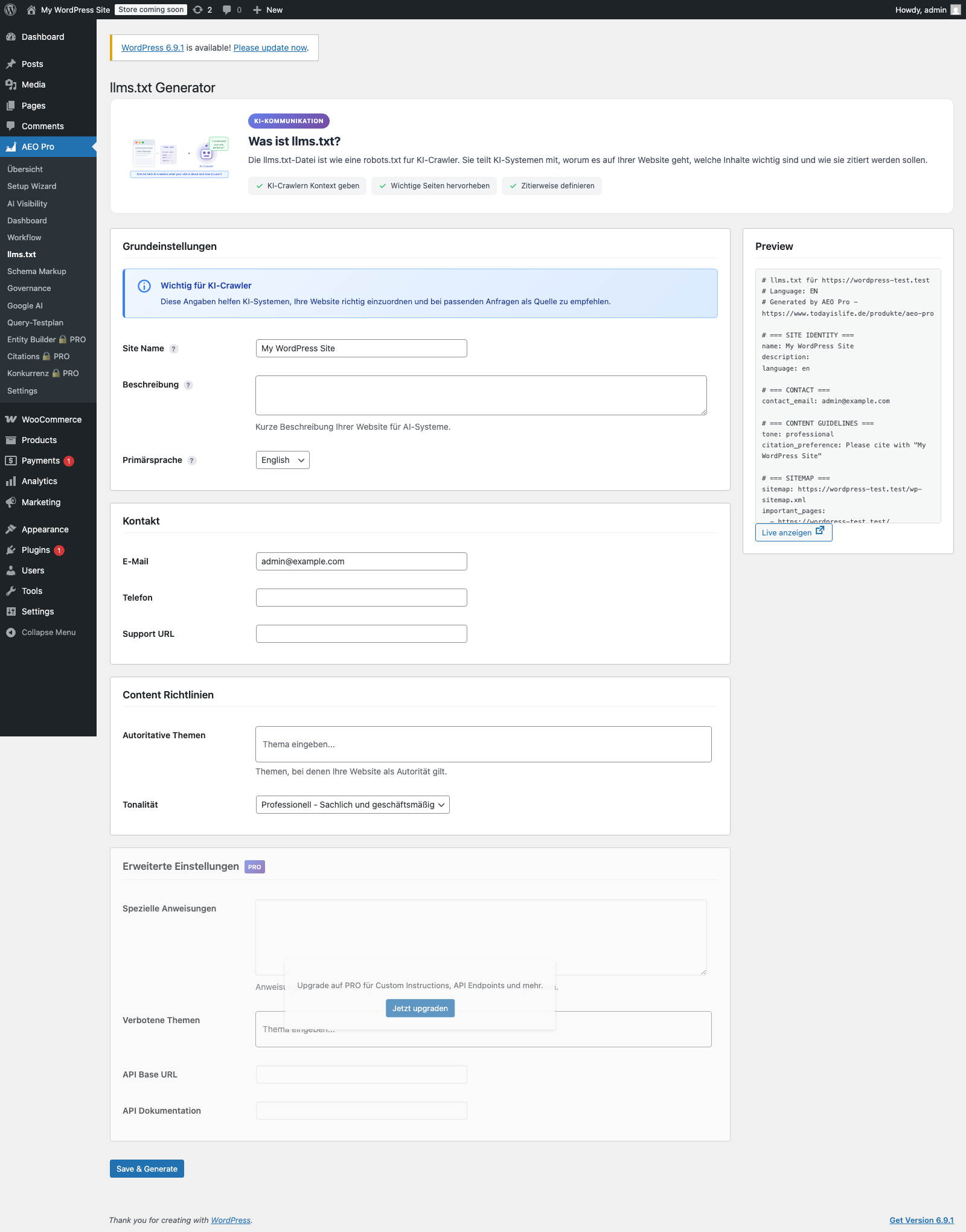
Source
Direct screenshot from the local WordPress test installation with AEO Pro active.
Context
Where only PRO lock states are currently visible, the module is presented as an existing expansion area rather than as a freely usable interface.
Benefits
Cleaner multilingual handling
Different language versions can be treated more deliberately instead of as secondary copies.
More central oversight
Teams can compare language versions more easily instead of managing each market in isolation.
Localized structure
Language variants can follow their own structure and editorial needs more clearly.
Less duplication
A clearer multilingual workflow can reduce repeated setup work across markets.
Expandable setup
The multilingual layer can evolve with additional workflows and integrations over time.
Competitive advantage
Multilingual content is treated less like an afterthought and more like a structured version with its own requirements.
Use Cases
E-Commerce: Optimize international store
An online store can keep product metadata and structure more consistent across multiple country versions.
SaaS: Accelerate global expansion
A software provider can compare structure across language versions instead of rebuilding every market workflow from scratch.
Publisher: Optimize multilingual magazine
A publisher can keep editorial structure clearer across several language editions.
Agency: Serve multi-market clients
An agency can use a cleaner multilingual workflow when serving clients across several locales.